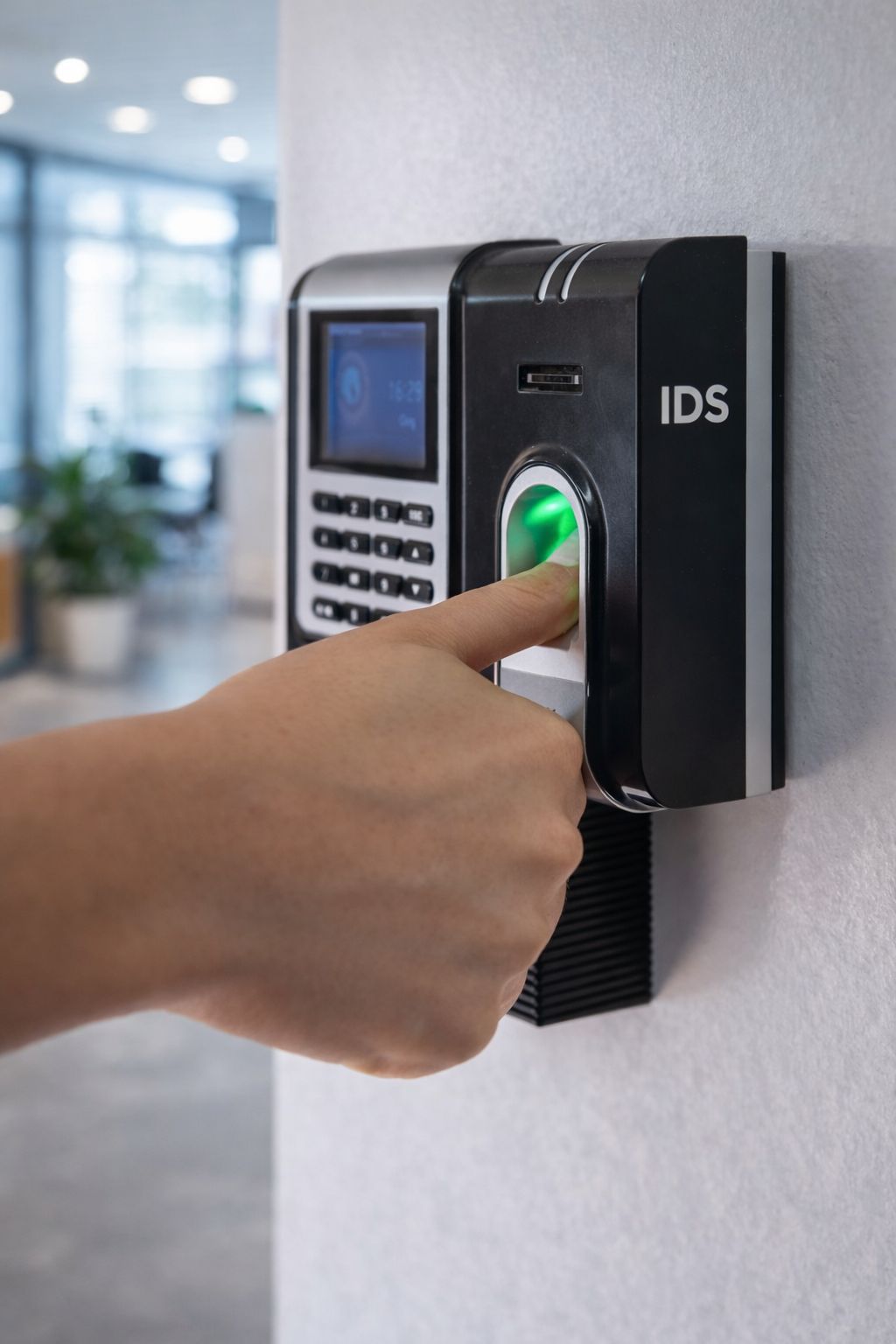
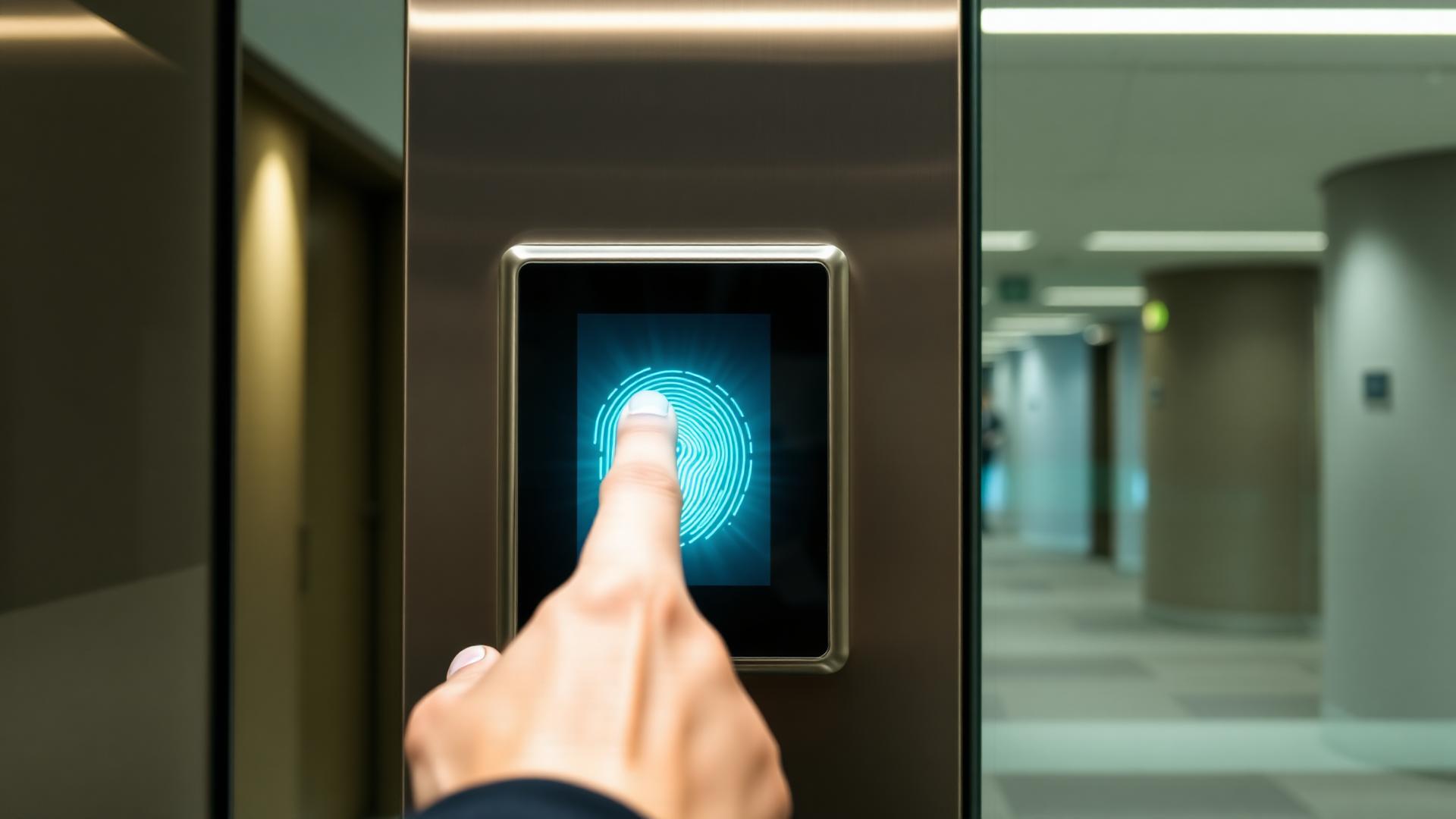
Close-up of a finger on a wall-mounted biometric fingerprint scanner at a modern office entrance
ZKTeco Authorised Installer

Biometric Access Control Systems South Africa — Fingerprint, Facial Recognition & Palm Scanners

ZKTeco authorised supply and installation across South Africa. Standalone or networked biometric systems for businesses, estates, and facilities of all sizes.

Let us help you build your solution

No obligation · ZKTeco Authorised Dealer · 25+ Years in Business

★★★★★ Google Reviews 25+ Years In Business ZKTeco Authorised Dealer Turnstar Authorised Partner Let us help you build your solution

Keys and Cards Leave Your Access Control Open to Abuse.

When employees share access cards, lose keys, or clock in for each other, your security system is compromised at its weakest point — the human element. Biometric access control replaces shared credentials with something that cannot be copied, lent, or faked.

Shared cards mean anyone can enter

Shared access cards mean anyone can enter — you have no way to know who was actually there.

Lost or stolen cards are a security incident

Lost or stolen cards are a security incident every time they happen.

Manual time records create disputes

Manual time records create payroll disputes and give HR no reliable data to work with.

IDS installs ZKTeco biometric systems that verify identity using fingerprint, facial recognition, or palm scan — and simultaneously log time and attendance. One device. One scan. No shared credentials.

Who Uses Biometric Access Control

Commercial Office Buildings

Warehouses & Industrial Facilities

Estates, Complexes & Security Villages

Schools, Government & Healthcare

What Our Clients Say

"IDS made the integration of time and attendance management with access control features absolutely seamless. Saving us time and providing advanced security. Highly recommended!"

Johnathan S.

Small Business Owner

"Your recommendations made managing our workforce a breeze. The biometric access system is efficient and secure, and the comprehensive reporting helps us optimise staffing patterns."

Alex M.

Operations Director

"The best decision I made as a facility manager. User-friendly interface and customisable access levels improved security, and integration with our timekeeping software streamlined payroll."

Michael B.

Facility Manager

"Impressed! The biometric time and attendance features have put an end to buddy punching, and their exceptional customer service provided personalised solutions. Definitely recommended!"

Kevin T.

Warehouse Manager

Trusted by leading South African businesses

EngenAshton WineryPienaar Brothers3C MetalSpice MeccaAstron Energy

Why Businesses Choose IDS

ZKTeco Authorised Dealer

Direct supply, full warranty, factory-backed support. Not a reseller — an authorised dealer.

25+ Years In Business

Independent Dynamic Solutions has installed access control across South Africa since 2000.

Supply AND Installation

One team, one guarantee. We supply what we install and install what we supply.

After-Sales Support

You call, we answer. Remote support and on-site returns for hardware faults.

Director-Backed Guarantee

Donavan Driver personally stands behind every recommendation we make.

Trusted by SA Businesses

Engen, Ashton Winery, Pienaar Brothers, 3C Metal, Spice Mecca and many more.

Frequently Asked Questions

We do both — and they are not separable for us. We supply every system we install, and we install every system we supply. This means there is no finger-pointing between a hardware vendor and an installation contractor. One call, one team, one guarantee.

Ready to Replace Cards and Keys with Biometrics?

Let us help you build your solution. No obligation. We recommend the right ZKTeco system for your access points.

Get Your Let us help you build your solution

We'll review your access points and recommend the right ZKTeco system. No obligation.

What do you need?

Biometric Access Control in South Africa — What It Is and What It Costs

Biometric access control replaces the card, tag or PIN with a physical characteristic that cannot be lent, lost or cloned. A reader captures a fingerprint, a face or a palm-vein pattern, converts it to a mathematical template, and compares that template against the enrolled database before releasing the door. The original image is not stored, which is what keeps the system practical under POPIA when it is configured correctly. IDS supplies and installs ZKTeco readers as an authorised dealer, so the hardware carries a manufacturer-backed warranty and direct technical support.

The technology is used wherever accountability matters more than convenience: office receptions and server rooms, factory and warehouse entrances, laboratories and clean rooms, school and campus buildings, mining sites, and estate clubhouses and gyms. In practice most sites are mixed — a facial terminal on the main entrance where hands are full or dirty, fingerprint readers on internal doors, and card credentials retained for visitors and contractors. All of it runs off one database, so a single enrolment governs every door a person may use, and a single deletion removes them from the whole site the moment they leave.

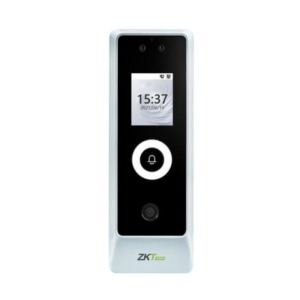
Deployments split into two categories. Standalone readers hold their own user list on the device and are the cheapest way to control one or two doors, but they have to be administered at the door. Networked systems put controllers on the LAN behind management software, which gives you central enrolment, live door status, anti-passback, time-based access rules, and an audit trail you can export. Networked is the right choice as soon as you have more than a handful of doors or more than one administrator.

Price is driven by four things: the number of doors, the reader technology, the door hardware, and integration. Each additional door needs its own reader, lock, power supply and cabling, so cost scales close to linearly. Fingerprint is the cheapest modality; facial recognition costs more; palm-vein and multi-modal terminals cost the most. Door hardware matters more than people expect — a magnetic lock on a glass door, a strike on a timber door, and a fire-rated door with a break-glass override are three different jobs. Integration with time and attendance, payroll, CCTV or an existing controller adds configuration time on top of hardware.

Typical price range

R6,000 – R15,000 per door installed; networked multi-door systems from R20,000

A single-door standalone fingerprint or facial reader, including lock, power supply and installation, typically lands between R6,000 and R15,000. Networked systems with management software and multiple readers usually start around R20,000 and scale with the door count.
Biometric Access Control — frequently asked questions

What is the difference between fingerprint and facial recognition access control?

Fingerprint readers are the cheapest reliable biometric and work well in clean, indoor environments. They struggle where hands are wet, dusty, cut or heavily calloused, which is common on industrial and food-handling sites. Facial recognition is contactless, faster at peak times, and unaffected by hand condition, but it costs more per terminal and needs sensible lighting and mounting height. Where both matter, a multi-modal terminal accepts face, fingerprint and card on the same unit.

Is biometric access control POPIA compliant?

Biometric data is special personal information under POPIA, so it has to be justified, minimised and secured. The readers we install store a mathematical template rather than an image of the fingerprint or face, which means the original biometric cannot be reconstructed from the database. You still need employee consent, a stated purpose, a retention period and controlled administrator access. We configure the system to support that and hand over an administrator who understands how to remove users properly.

Can biometric readers work if the network or power goes down?

Yes, when they are specified for it. Controllers and readers hold their user list locally, so doors keep working normally if the network link to the server drops, and events are buffered and uploaded when the link returns. Battery-backed power supplies keep the hardware live through a load-shedding slot. Fail-safe or fail-secure behaviour on each door is chosen up front, with break-glass overrides on escape routes.

How many users can a biometric system hold?

Entry-level standalone terminals typically hold between 1,000 and 3,000 fingerprint templates and a similar number of cards. Mid-range facial terminals commonly hold several thousand faces plus separate card and password credentials. Server-based networked systems are effectively limited by the database rather than the reader. We size the terminal to your headcount plus expected growth so you are not replacing hardware in two years.